
103. Clasp
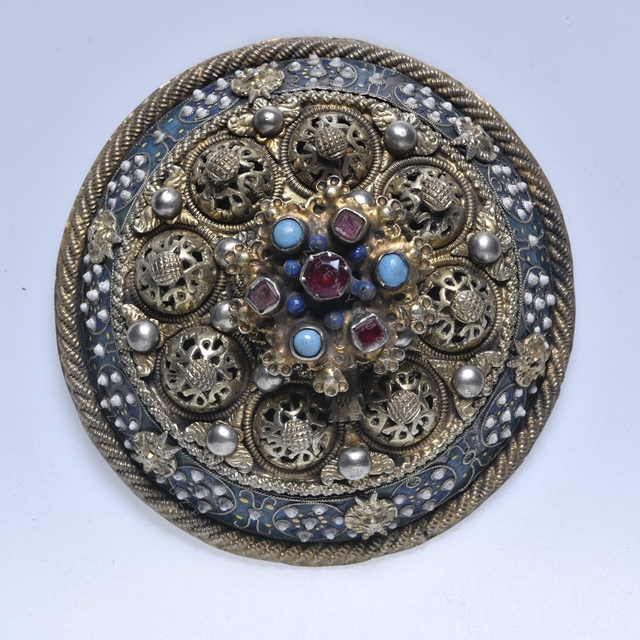
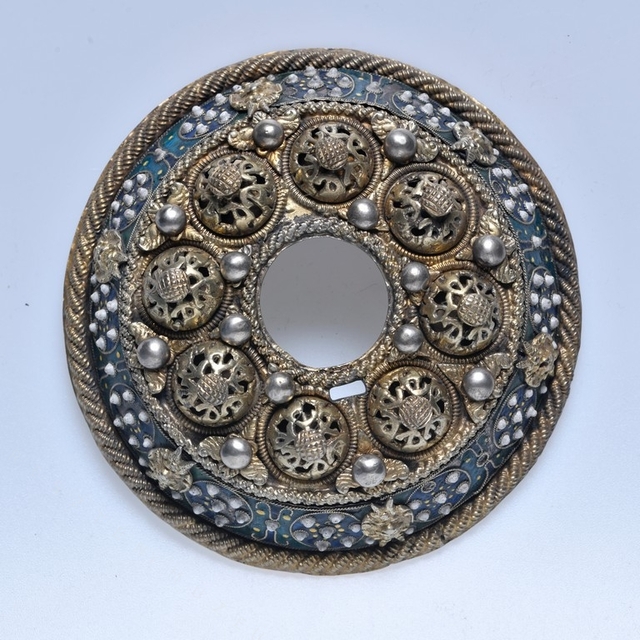
The rim of the exhibited breast clasp is encircled by twisted gilded wire. Above it runs a band enamelled in blue and divided into fields with rounded corners; within these fields are rosettes made up of tiny globules arranged in circular forms, recalling pearl decoration. Between the fields, screws concealed as lion-mask heads fasten the plate. From the base of the convex central field of the enamelled band rise eight openwork ornaments reminiscent of bosses. The spaces between them are decorated, both on the lower and upper parts of the raised band, with the same small globules seen on the lower band, though here they are larger and made of silver. The central section is closed at the top by a large removable rosette, crowned in the middle by a splendid red gemstone; its “petals” are set alternately with red gemstones and turquoises.
The breast clasp, known among the Transylvanian Saxons as a Heftel, and according to Péter Apor’s testimony from 1736 called kesentyű or kösöntyű in old Hungarian, is one of the masterpieces of seventeenth-century goldsmiths’ work. Once fashionable among both urban burgher women and village women, from the second half or end of the nineteenth century this large piece of jewellery was worn mainly by rural women, placed between two parts of their costume: the long gown and the bodice, or pruszlik, beneath it.
The size, form and many technical elements of Transylvanian Saxon women’s breast clasps — including the filigree enamel that decorates many examples — recall the construction of clasps used on medieval ecclesiastical and secular cloaks, and draw on their techniques. For centuries these clasps were made of gilded silver; in the nineteenth century, however, they were often made “only” of gilded copper or brass.