
71. Cup
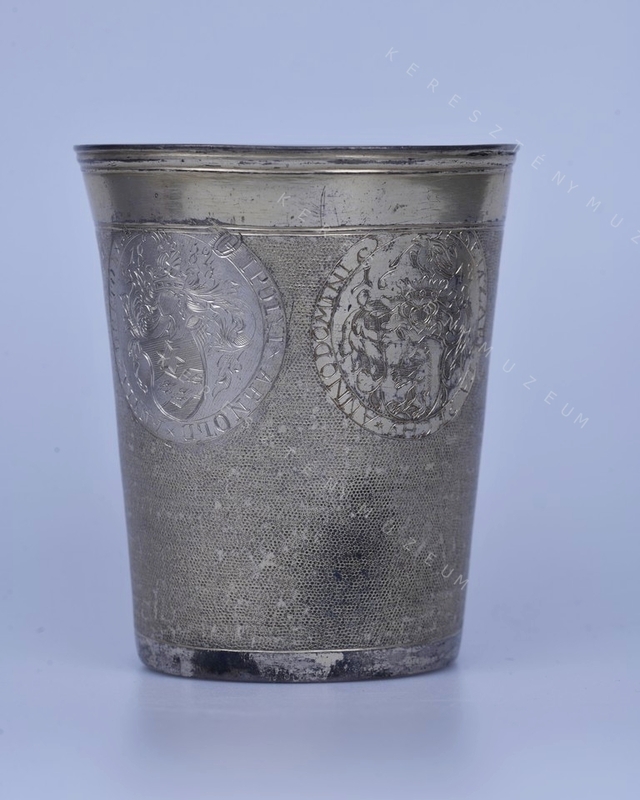
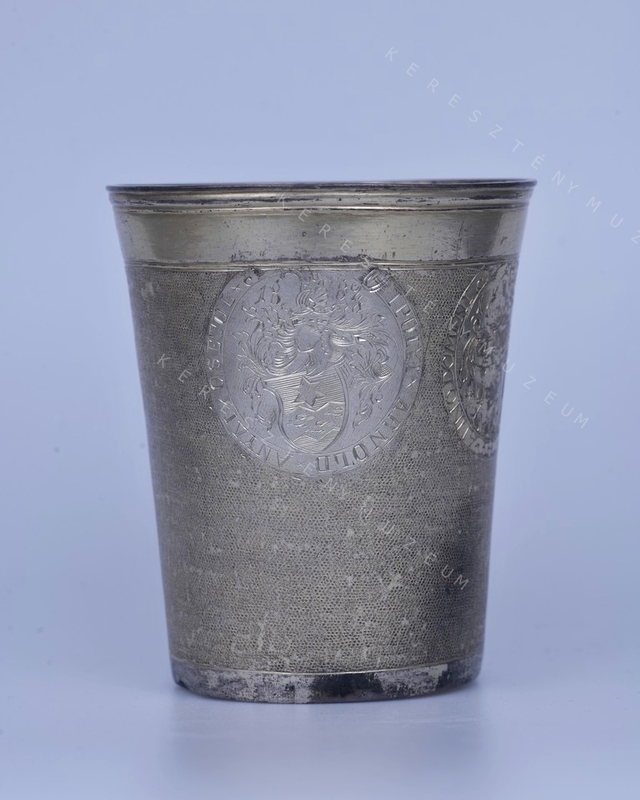
This repoussé and engraved silver 'shark cup' (Hung.: cápás pohár), with a cylindrical body widening towards the rim, occupies a special place in the collection of the Christian Museum in Esztergom. It entered the museum not only from the estate of one of the “founding fathers” of its collections, but was also almost certainly in Ipolyi Arnolds’s personal use, as indicated by the Ipolyi coat of arms and the date 1882 on the body of the cup. The body is also decorated with the coat of arms of the former owner of the object, Erzsébet Péchy, together with the date 1648. The cup is a masterpiece by Jacobus (Jakob) Schliesser — also written Schließer or Schlesser — a goldsmith of Nagyszeben, active between 1641/1642 and 1671. Schliesser probably settled in Nagyszeben during his journeyman years, and was admitted there as a master goldsmith on 30 November 1641. According to the present state of research, he used his maker’s mark only from 1642 onwards, and therefore almost certainly began his activity at that time. In his workshop in Reispergergasse he worked with three assistants or apprentices. His son, Hansig Schliesser, entered the workshop of the goldsmith Daniel Kroner, also located in Reispergergasse, as an apprentice on 18 July 1671; by that time Jacobus Schliesser was no longer alive. A partly gilded silver covered tankard by Schliesser, decorated on the inside of its lid with a gilded Roman medal, is preserved in the collection of the Hungarian National Museum in Budapest, inv. no. 1955.8.C. Further covered tankards by him are held in the Lutheran church of Szászorbó — German: Urwegen; Saxon: Urbihen, Ausendref; Romanian, and today: Gârbova, formerly Gârbova Săsească, Alba County, Romania — dating from 1645, and in the Brukenthal Museum in Sibiu, inv. no. T.86/14905. In addition to these, works by Schliesser are also preserved in other Hungarian and foreign collections, including private collections.
Terézia Bardi, 2026